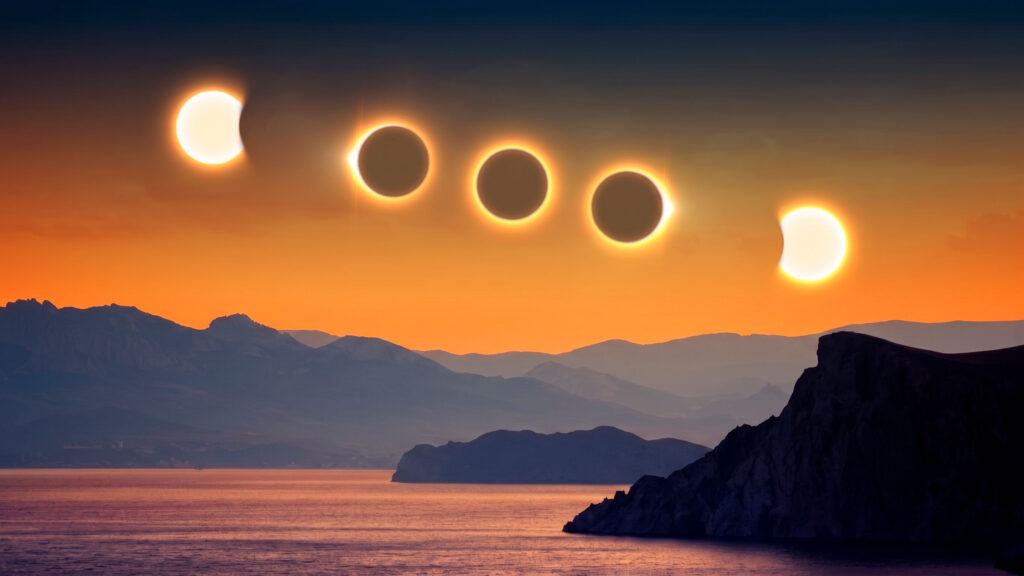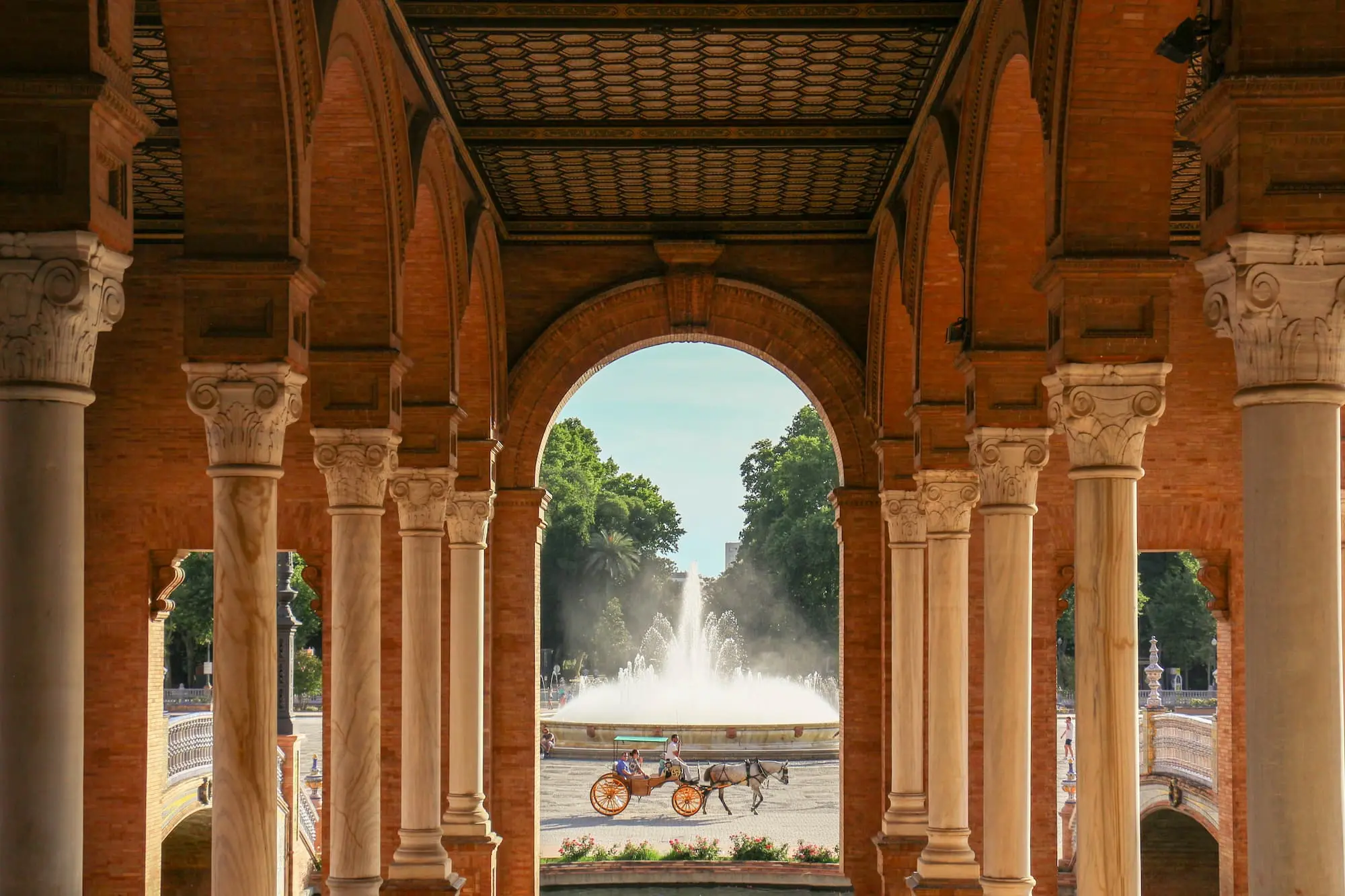




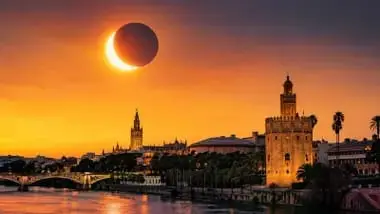
Updated on 6 August 2026. The solar eclipse in Seville on Wednesday 12 August 2026 will be the most spectacular astronomical event seen over the city in more than a century: the Moon will cover 94.6% of the solar disc just before sunset.
Although Seville lies outside the path of totality, the obscuration will be so high that the afternoon light will noticeably dim and the Sun will become a thin luminous crescent on the western horizon. Just be aware: you will need a spot with a completely clear western horizon and ISO 12312-2 certified glasses for the whole event, without exception.
The solar eclipse in Seville, in 30 seconds
- When: Wednesday 12 August 2026, afternoon into evening.
- Starts: around 19:40 (Peninsular Spanish time).
- Maximum: around 20:37, with 94.6% of the Sun hidden.
- Ends: the Sun sets (around 21:15) still eclipsed, so the final phase will not be visible from Seville.
- Height of the Sun at maximum: about 7º above the horizon. Any building or trees to the west will block it.
- Protection: required at all times. In Seville it is never safe to take off your eclipse glasses.
What time is the solar eclipse in Seville?
These are the timings of the solar eclipse in the city of Seville on 12 August 2026, in Peninsular Spanish time:
| Eclipse phase | Approximate time | What you will see |
|---|---|---|
| First contact (start) | 19:40 h | A small bite taken out of the edge of the Sun |
| Maximum eclipse | 20:37 h | 94.6% of the Sun covered; the light drops noticeably |
| Sunset | 21:15 h | The Sun sets still eclipsed, on the western horizon |
| End of the eclipse | Not visible | Occurs after the Sun has already set |
The differences between municipalities in the province (Dos Hermanas, Alcalá de Guadaíra, Utrera, Écija, Carmona, Osuna or the Aljarafe) are only one or two minutes, so this timetable works for the whole metropolitan area. If you want the exact minute for your town, you can check it on the official viewer of the Instituto Geográfico Nacional.
The most important detail of the timetable is not the time but the height of the Sun: at maximum it will be about 7º above the horizon, about the height of a four-storey building seen from halfway down the street. That is why choosing the right spot matters more than arriving on time.
What will happen during the eclipse of 12 August 2026?
A solar eclipse occurs when the Moon passes between the Earth and the Sun and hides it, totally or partially, from certain places on the planet.
The eclipse of 12 August 2026 will be total along a band that crosses Greenland, Iceland, the Atlantic Ocean and much of Spain. In our country, totality will sweep across the northern half of the peninsula and pass cities such as A Coruña, Oviedo, León, Bilbao, Zaragoza and Valencia. It will be the first total solar eclipse visible from the Iberian Peninsula in more than a century, as the Instituto Geográfico Nacional reminds us.
Spain is also at the end of the path of the lunar shadow, so the key moment occurs with the Sun very low, almost touching the horizon. From Andalusia, and specifically during the solar eclipse in Seville, there will be no totality, but the obscuration will be so high that a clear drop in ambient light will be noticed, along with a sunset with a strange, metallic colour that is hard to forget.
Will the solar eclipse in Seville be total?
No. From Seville we will see a partial solar eclipse of approximately 94.6%.
That means a small part of the Sun's bright surface will always remain visible. Although it may seem insignificant, that remaining 5% still emits more than enough radiation to cause serious, irreversible damage to the retina.
Therefore, from Seville there will not be a single moment when it is safe to remove your eclipse glasses to look directly at the Sun. Removing protection is only permitted during the totality phase and within the geographic band where the Moon completely covers the solar disc. Seville is not in that band: the nearest totality zone is more than 500 kilometres away, in the northern half of the country.
Where to see the solar eclipse in Seville: the best spots
The number one requirement for enjoying the solar eclipse in Seville is a wide view towards the west, where the Sun will be during sunset. A good observation point should have these features:
- Clear western horizon, with no buildings, trees or hills in front.
- Enough space to observe safely and without crowds.
- Easy, planned access without blocking roads or paths.
- A safe distance from areas at risk of forest fire.
Expert tip: visit your chosen spot any evening this week around 20:30 and check exactly where the Sun sets. It is the only way to make sure a block of flats does not hide it on 12 August.
In the city: open spaces and viewpoints
Within Seville city, the best spots are wide open spaces by the river and high vantage points, as long as the view to the west is clear:
- Parque del Alamillo, for its large, open meadows.
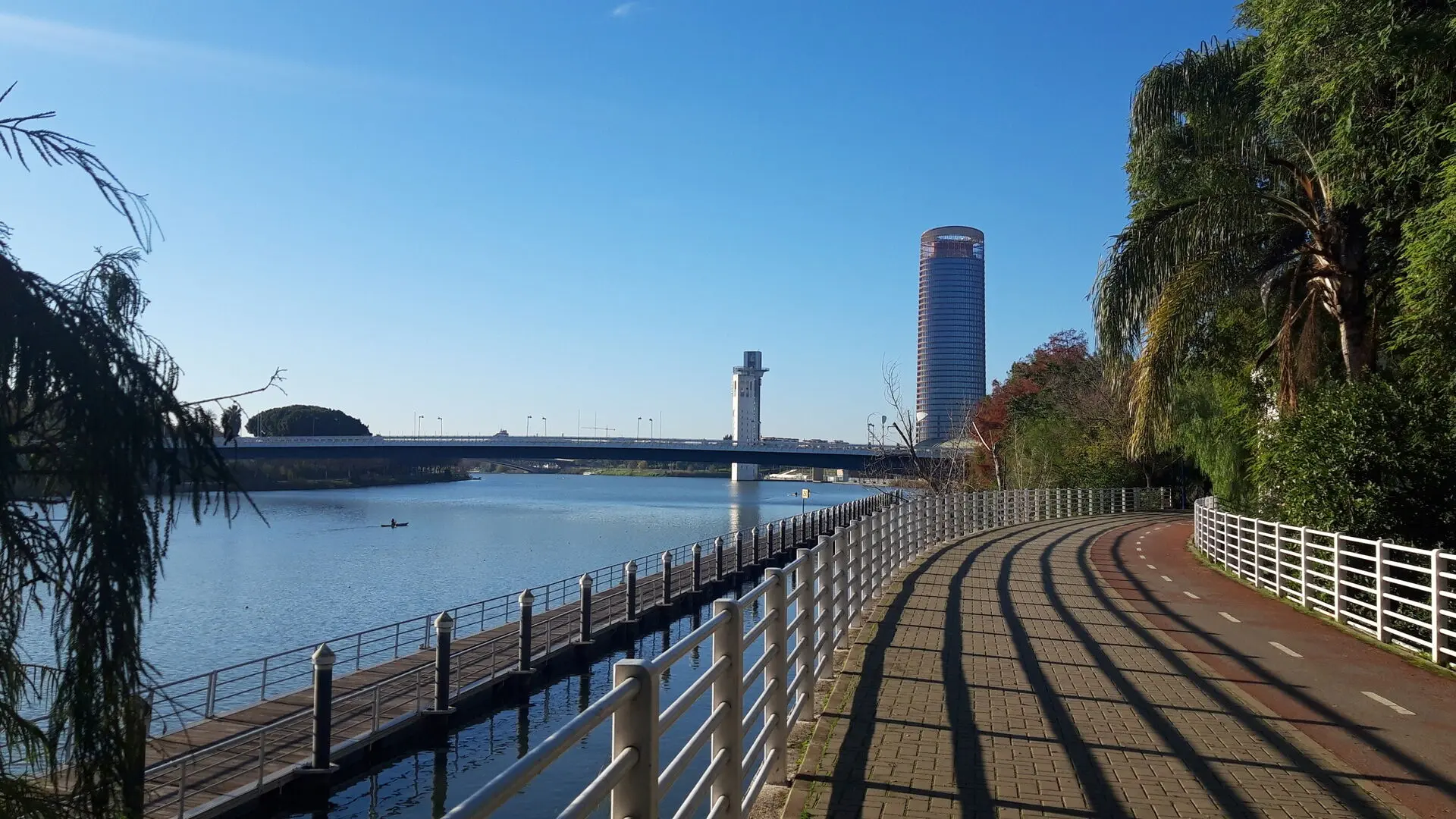
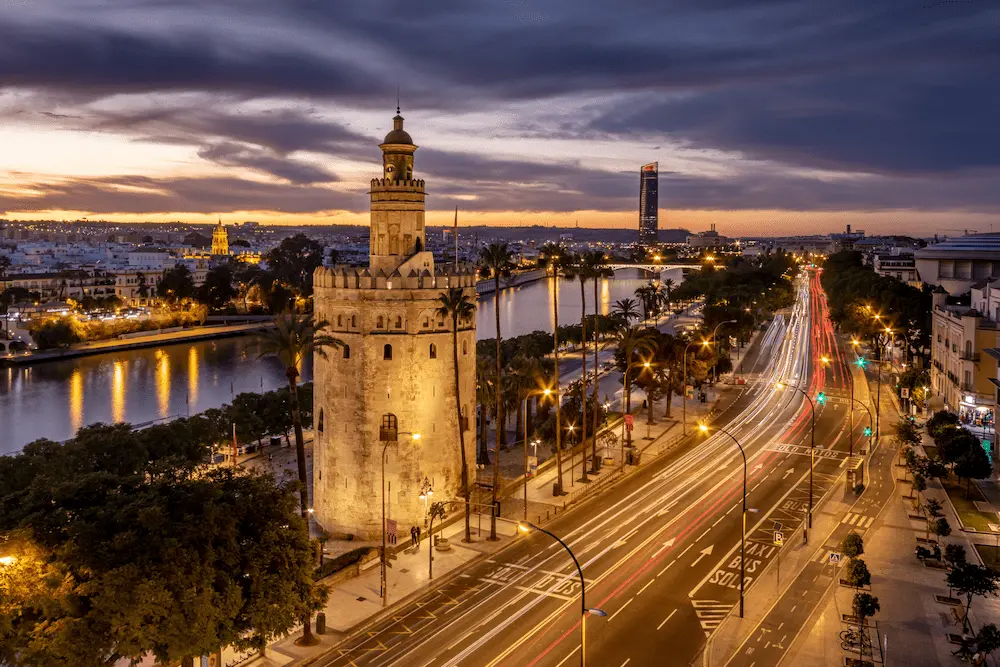
- Guadalquivir riverbanks (Muelle de las Delicias, Charco de la Pava, the area around the Torre del Oro), where the river opens up the horizon.
- Elevated urban viewpoints, such as the Setas de Sevilla or the Torre Sevilla viewpoint; check opening hours and tickets in advance, as demand will be very high that day.
- Terraces and rooftops with western views. If you'd rather watch with a drink in hand, take a look at our selection of terraces in Seville and book ahead.
In the Aljarafe and the Guadalquivir plain
Just a few minutes from the city there is plenty of open countryside. In the Aljarafe (Espartinas, Umbrete, Bollullos de la Mitación, Villanueva del Ariscal) you'll find tracks and high ground with a clear western horizon. In the plain (La Rinconada, Alcalá del Río, Guillena) the flat terrain also makes it easy to see the Sun very low. Always park in designated areas and don't enter private estates.
Watching the eclipse from the Sevillian Sierra Morena
The Sierra Morena de Sevilla offers less light pollution and large natural spaces, ideal if you also want to stay and watch the stars afterwards. Towns to consider include Almadén de la Plata, Constantina, El Pedroso and Las Navas de la Concepción.
Check access routes, possible restrictions and organised activities in each municipality beforehand. August is a high fire-risk month: don't park on tracks, don't enter restricted areas, don't light fires and don't leave any waste.
Is it worth travelling to the totality path?
94.6% and 100% are nothing alike: totality is the only phase where the solar corona appears, and it gets almost night-like. But from Seville we're talking about more than 500 kilometres of travel, accommodation sold out in many areas and very busy roads that day. If you don't already have a booking, the sensible option is to enjoy the partial eclipse from home, with the bonus of a unique sunset over the Guadalquivir.
Eclipse glasses for watching the solar eclipse in Seville: what to buy and what to avoid
To look directly at the Sun, only eclipse glasses or solar viewers that meet the ISO 12312-2 international standard are safe. This standard sets limits on ultraviolet, visible and infrared radiation transmission, as well as requirements for quality, filter uniformity and labelling.
They are not dark sunglasses: their filters are thousands of times denser and are designed exclusively for direct solar observation.
How to check that your eclipse glasses are safe
- They clearly indicate that they comply with the ISO 12312-2 standard.
- They clearly identify the manufacturer or distributor.
- The filter has no scratches, holes, creases or peeling areas.
- When you put them on indoors you see absolutely nothing, except a very bright light bulb, which will appear faint.
- They come from an optician, an astronomy shop or a trusted distributor, not an unknown seller.
Beware of counterfeits: the “ISO 12312-2” label printed on the frame guarantees nothing on its own, as the American Astronomical Society warns. Buy from opticians, astronomy groups or specialist shops, and do it now: they sell out in the week before the eclipse.
If your neighbourhood has an astronomy group, a civic centre or a science museum organising a public viewing, that's the best option: they usually have telescopes with solar filters and staff who know how to use them.
What is NOT safe for looking at the Sun
- Sunglasses, even polarised or top-category ones.
- X-rays, photographic negatives or smoked glass.
- CDs, DVDs, dark bottles, water, tinted plastics or welding glass without the right density.
- Binoculars, telescopes or telephoto lenses without a solar filter in front of the objective: they concentrate light and can destroy the glasses' filter and your eyesight in a second.
- Looking “just for a moment” with the naked eye. Retinal damage is painless and can be permanent.
How to watch the eclipse without glasses: pinhole projection
If you run out of certified glasses, you can still follow the eclipse completely safely without looking at the Sun. The classic method is pinhole projection: make a small hole in a piece of cardboard, place it with your back to the Sun and observe the projected image on the ground or on another white card. You'll see the solar disc bitten by the Moon.
It works just as well with a kitchen sieve, a slotted spoon or even the shadows cast by tree leaves: during the solar eclipse in Seville, the ground beneath the orange trees will fill with hundreds of small crescent-shaped suns. It's also the best photo you'll take that day.
How to photograph the solar eclipse in Seville with your phone
Photographing the solar eclipse in Seville is easy if you accept one thing: your phone won't capture the Sun the way you see it. With these tricks, at least you won't come home with an overexposed white blob.
- Never look at the Sun through the viewfinder of a DSLR camera or through a telephoto lens without a solar filter.
- With a phone, the homemade trick is to place eclipse glasses in front of the lens: the photo comes out much better exposed and you protect the sensor.
- Lower the exposure manually by tapping the screen and dragging down; on auto the Sun comes out as a white smudge.
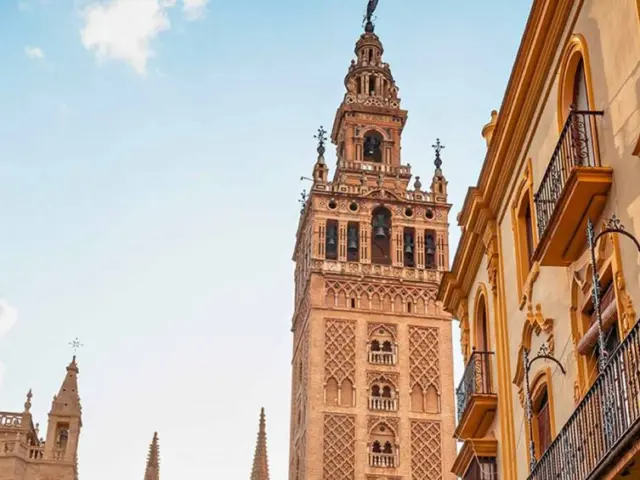
- Look for a recognisable foreground (the Giralda, a bridge, an olive tree) and compose with the Sun in the background: that's what makes the photo work.
- Don't obsess over the camera. The best part of the eclipse is the light around it, not the Sun itself.
And if it's cloudy? Weather forecast for Seville
The odds are in favour of the solar eclipse in Seville: in mid-August clear skies are the norm across the province of Seville. Even so, the only reliable forecast is the one for the days beforehand, and at that point in the evening a simple band of haze or low cloud on the western horizon can spoil the view.
Check the AEMET forecast for Seville for 10 and 11 August and have a plan B ready half an hour's drive away, preferably towards the north or west of the province.
Eclipse and the Perseids: a once-in-a-lifetime night sky
The solar eclipse in Seville coincides almost exactly with the peak of the Perseids, the most popular meteor shower of the year, and with the new Moon, so the sky will be especially dark after sunset.
If you head out to the countryside to watch the eclipse, it's worth bringing a blanket, a picnic dinner and staying on: between midnight and dawn is when the most meteors can be seen. Two astronomical spectacles in the same night don't happen every summer.
What to do in Seville on 12 August before the eclipse
The eclipse begins at 19:40, so you have the whole day ahead of you (and plenty of heat to dodge). A few ideas to fill the day:
- Spend the morning soaking up the sun: here are the best hotels with pools and day passes in Seville.
- Leave the city and return for sunset with our day trips near Seville to beat the heat.
- Check the concert, summer cinema and weekly plans listings in what to do in Seville.
- Book a table on a terrace with a view and stay for dinner after the eclipse.
Frequently asked questions about the solar eclipse in Seville
When is the solar eclipse in Seville?
On Wednesday 12 August 2026. It begins around 19:40, reaches its maximum at about 20:37 and continues until sunset, at around 21:15.
What percentage of the Sun will be covered in Seville?
The Moon will cover approximately 94.6% of the solar disc as seen from Seville, one of the highest percentages in western Andalusia.
Will it get dark during the eclipse?
Not completely, because the eclipse will be partial. You will notice a clear drop in light, a leaden atmosphere and a slight fall in temperature during the central minutes.
Can you look at the eclipse through sunglasses?
No. Ordinary sunglasses, however dark they are, do not filter out the necessary radiation and do not protect against direct viewing of the Sun.
Which glasses are safe for viewing the eclipse?
Only solar viewers that comply with the international standard ISO 12312-2 and come from a reliable manufacturer or distributor, in perfect condition and without scratches.
Can I take my glasses off at the peak of the eclipse?
Not from Seville. As there is no totality, a part of the Sun always remains visible and eye protection must be kept on throughout the phenomenon.
Where will the solar eclipse be best seen in Seville?
In open or elevated places with a clear horizon to the west: Parque del Alamillo, the banks of the Guadalquivir, the city's viewpoints, the Aljarafe, the vega or the Sevillian Sierra Morena.
Can I watch the eclipse if I can't get approved glasses?
Yes, through pinhole projection: a card with a hole, a kitchen colander or the shadow of tree leaves will project the image of the eclipsed Sun without any risk to your eyesight.
When will the next eclipse visible from Seville be?
Spain will see another solar eclipse in 2027 and another in 2028, and for the 2 August 2027 eclipse the path of totality will indeed cross the south of the peninsula, very close to Andalusia. The one on 12 August 2026 is the appetiser to an unrepeatable sequence.
A historic event over the Seville sky
The solar eclipse in Seville on 12 August 2026 will be an extraordinary opportunity to watch the Moon almost completely hide the Sun just as it sets over the Aljarafe. The combination of 94.6% coverage, the sunset and good chances of clear skies could make it an unforgettable experience.
The key lies in three things: choosing your spot in advance, avoiding last-minute travel and using glasses that comply with the ISO 12312-2 standard throughout the phenomenon.
Because looking up at the sky can be a unique experience, but it should always be done with your eyes properly protected.